Glasgow · 26–27 November 2026
RSE Learning Environment Hackathon
Two days of building an open RSE learning environment — and other research software engineering tools — in Glasgow.
For active RSEs, educational technology researchers, and anyone teaching with code — on site or hybrid.
Research Software Engineering (RSE) practice and training remain fragmented along disciplinary lines: each field reinvents tooling, conventions, and teaching material, so we will conduct an open hackathon to prototype discipline-overarching RSE frameworks — shared, reusable building blocks that work across the sciences rather than within a single silo.
Who should come
This is a hackathon for code-affine people from teaching and from the RSE world. In the UK, teaching RSE is often a job description in its own right; in Germany it is usually a role people grow into. Either way, you are who we are looking for:
Active RSEs
Research software engineers who build the real thing — and who pass the practice on in workshops, courses or summer schools, whether or not that part is in your job description.
Educational technology researchers
People who research, build and run learning technology — LMS integrations, standards, autograding, JupyterHub estates. You know why the last integration hurt, and what the literature says.
Lecturers with software projects
Instructors who guide students through research-adjacent software projects: version control, code review, teams, deadlines, an artefact at the end that someone has to assess.
Anyone teaching with notebooks or R
Teaching with notebooks or R day to day. Your assignments are exactly the runnable artefacts today’s learning environments handle so poorly.
You do not need to be all four. The mix is the point: our best case for these two days is a room where the UK and German RSE communities meet the educational-technology people, and where teachers and building RSEs are represented in roughly equal measure — so that whatever we prototype is both usable in a real course and buildable beyond the hackathon.
The flagship idea: an RSE learning environment
RSE teaching material is plentiful and much of it is excellent. A shared environment in which learners actually work is not. Oxford RSE’s Gutenberg gets furthest — open source, with accounts, courses and progress tracking — but the loop between learners is still open everywhere: group formation, submitting an artefact, getting feedback, reviewing someone else’s code. So learners read about good practice instead of practising it on each other’s code.
Notebooks, not pages
Traditional learning environments (Moodle, Canvas, ILIAS) were built for self-contained documents and quizzes. None of them embeds a Jupyter or R notebook well as a first-class, runnable assignment.
Real compute, not toy examples
RSE assignments need the machines RSE actually runs on: GPUs, batch schedulers, HPC allocations, containers. No LMS can embed an exercise that has to be submitted to a cluster.
OER in, OER out
What learners and instructors produce should leave the platform again as open educational resources — as notebooks and as standards-described learning objects, not locked in a course shell.
The challenge for the two days
A minimal working example of the pipeline: simple user management, group formation, a feedback loop, and peer assessment for uploaded RSE artefacts.
We use a thin-slice approach: rather than spending the two days building a complete database or UI, we connect just enough of each layer to show a user interacting with a real, working feature — alongside an overall system design (UML or similar) to carry the work forward.
Standards, architecture and the open questions →
A breakdown into modules that a single team can take on in two days, and what we think the two days can realistically produce, is on the modules page.
Other ideas for projects and prototyping are of course more than welcome!
Practical information
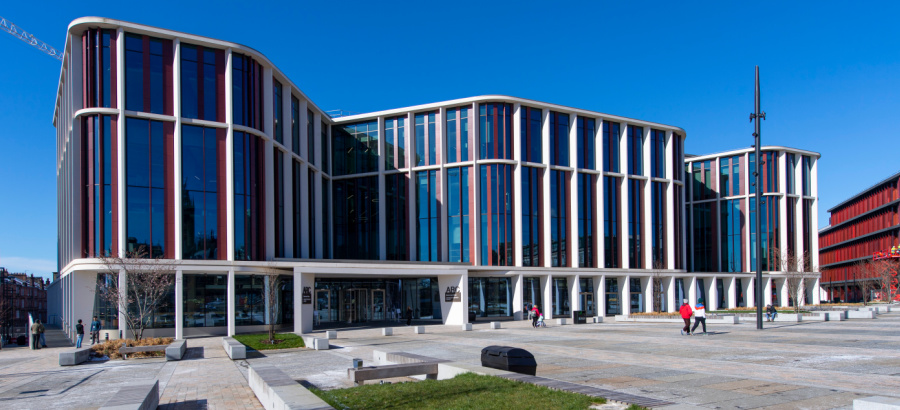
The hackathon takes place at University of Glasgow, Scotland on the 26th and 27th of November, 2026 at the Advanced Research Centre at University of Glasgow, 11 Chapel Lane, G11 6EW. Both days run from 09:00 to 18:00; coffee and lunch are provided.
How to get there: airports, trains, Subway and the walk to the ARC →
Hybrid attendance for remote contributors is also possible.
Join the conversation on our Matrix room.
The best artefact of the two days receives the Best Artefact Award.